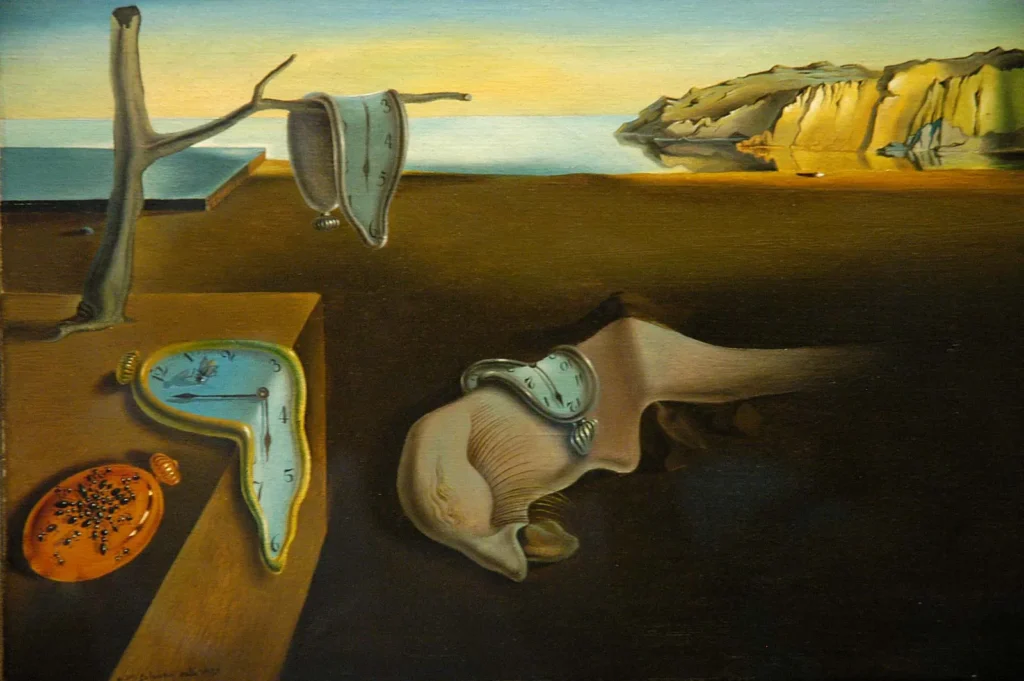
The Persistence of Memory
This is arguably Dalí’s most famous painting, picturing this disillusioned world where clocks are seen to be dried up, giving a distorted image of a world so imaginary and alternative. This creates time to be more of a fluid concept, something the subconscious mind can’t comprehend. It seems as if Dalí is trying to depict his life by how the landscape is, just like his hometown in Catalonia.
Artist: Salvador Dalí
Year: 1931
Medium: Oil on Canvas
Dimensions: 24 cm x 33 cm (9.5 in x 13 in)
Owner: Museum of Modern Art
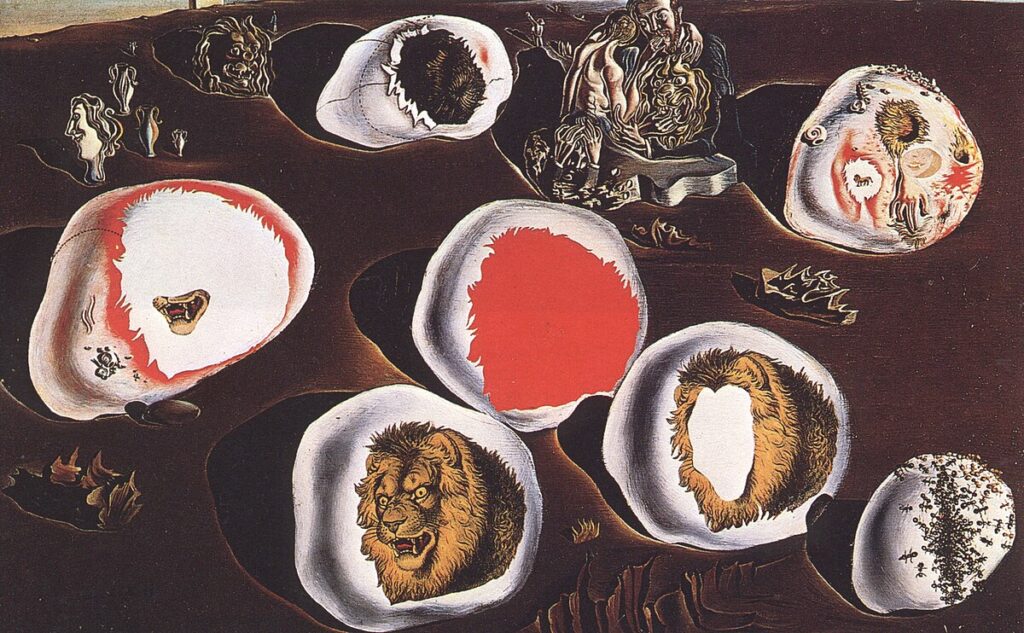
The Accommodations of Desire
Offers a stark insight into a climactic, deeply personal instant for the artist and for Surrealism. Born from the anxiety and passion of his affair with Gala Eluard, the small oil and collage on wood displays sleek pebbles heavy with symbolic imagery. The lion heads, sharply cut with a children’s book, and the repeating Dalí ant motif, which recurs throughout the painting, express his repressed fears and desires toward this forbidden love. The painting is remarkable for its unvarnished, psychological honesty and for its pioneering combination of painstaking realism and collage, which harnesses the unconscious bracingly into the open. It illustrated the Surrealist fascination with the irrational and dreams, acting as an early visual success for Dalí’s career.
Artist:Salvador Dalí (Spanish, Figueres 1904–1989 Figueres)
Date: 1929
Medium: Oil and cut-and-pasted printed paper on wood
Dimensions: 8 3/4 × 13 3/4 in. (22.2 × 34.9 cm)
Rights and Reproduction: © 2025 Artists Rights Society (ARS), New York
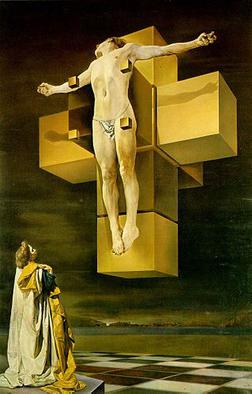
Crucifixion (Corpus Hypercubus)
Imagine Dalí, a man known for his wild dreams, turning his gaze towards something as immense and personal as faith. In his 1954 “Crucifixion (Corpus Hypercubus),” he doesn’t just paint a scene; he tries to hold the divine and the scientific in the same breath. Christ floats, not on a wooden cross, but before a complex, unfolded hypercube, with Gala, his wife, as a serene, witnessing Mary. It’s a profoundly human quest for understanding, using a new visual language of “Nuclear Mysticism.” While created after his main Surrealist period, it showed Dalí pushing his unique vision beyond, challenging traditional religious art and making us feel the awe of the spiritual through a startlingly modern, almost mathematical lens.
Artist: Salvador Dalí (Spanish, Figueres 1904–1989 Figueres)
Date: 1954
Medium: Oil on canvas
Dimensions: 76 1/2 × 48 3/4 in. (194.3 × 123.8 cm)
Rights and Reproduction: © 2025 Artists Rights Society (ARS), New York
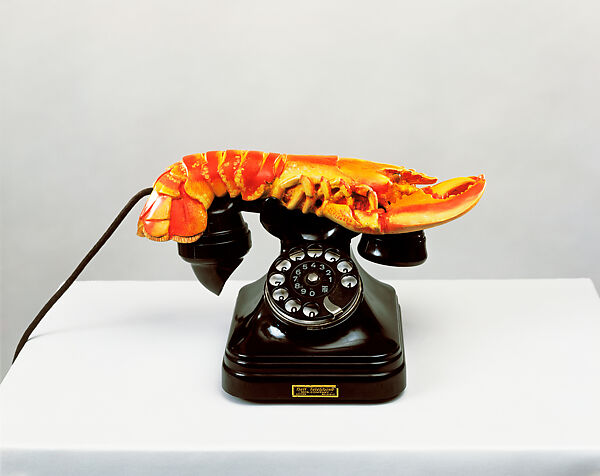
Téléphone-homard (Lobster Telephone)
This theatrical object is precisely what it describes: a working Bakelite telephone whose receiver has been substituted with a grotesquely convincing plaster lobster. It is quite the Surrealist painting, the peak of the style’s fondness for unsettling images that defy reality. To Dalí, lobsters were symbols of erotic and unconscious meaning; placing one on top of an instrument of communication is a disconcertingly humorous, ominously unsettling bridge between stifled urge and daily contact, one easily missed without knowledge of Dalí’s personal iconology. While a few were constructed, Dalí at one point suggested that the lobsters be actual and stuffed with mayonnaise, a preposterous detail that, although never carried out, ideally illustrates his desire to mix the visceral with the ordinary, always surprising us with the ability of art to transform the familiar.
Artist:Salvador Dali
Date: 1938
Medium: Steel,plaster,rubber,resin and sand paper
Dimensions: 7 x 13 x 7 in. (17.8 x 33 x 17.8 cm)
Rights and Reproduction: © 2025 Salvador Dalí, Fundació Gala-Salvador Dalí, Artists Rights Society. Photo © Tate
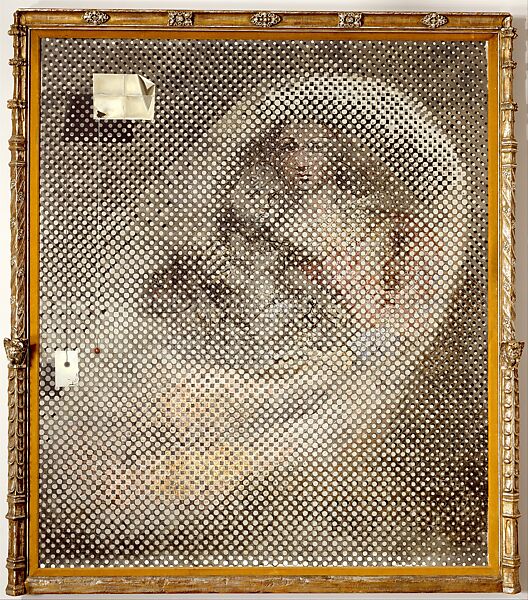
Madonna of Port Lligat
In post-war Port Lligat, circa 1949, Salvador Dalí, having embraced both Catholicism and his new “Nuclear Mysticism,” turned his visionary focus to sacred art. His painting titled “The Madonna of Port Lligat,” features his wife Gala as a serene, levitating Virgin. Her figure, along with symbolic elements like a shell or an egg, appears dematerialized, fragmented yet held in perfect suspension, as if composed of atomic particles governed by divine forces. The floating pieces are not chaotic but suggest a higher, invisible spiritual order. Dalí created two main versions of this subject, each revealing an unexpectedly reverent and deeply personal exploration of faith from the master of Surrealism, aiming to make spiritual mysteries tangible within an atomic age.
Artist:Salvador Dali
Date: 1958
Medium: Oil on canvas
Dimensions: 88 7/8 × 75 1/4 in. (225.7 × 191.1 cm)
Rights and Reproduction: © 2025 Artists Rights Society (ARS), New York
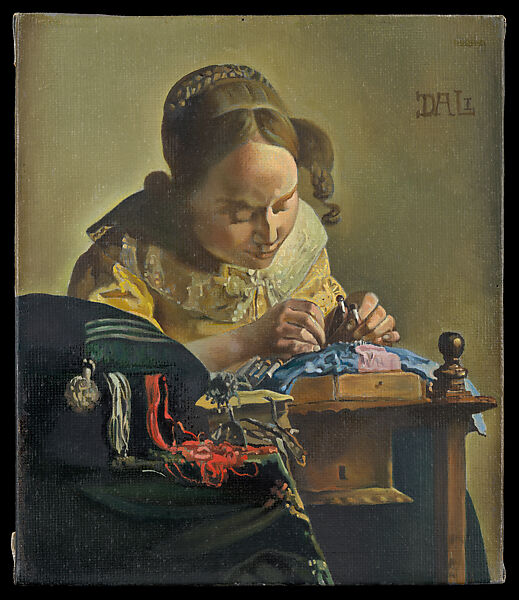
The Lacemaker (after Vermeer)
In 1955, Salvador Dalí looked at Vermeer’s famous painting, “The Lacemaker,” and saw something more, a hidden secret within its calm scene. So, Dalí painted his own version, but with an astonishing twist: Vermeer’s gentle image seems to explode into many rhinoceros horns. For Dalí, these horn shapes were perfect, almost sacred, and he believed Vermeer’s original painting was secretly built using their mathematical curves. Using his special “paranoiac-critical” way of seeing, Dalí felt he was uncovering the classic painting’s true, underlying structure. This wasn’t Dalí being disrespectful; it was his unique and deeply personal way of honoring Vermeer. This work powerfully showed Dalí’s lasting importance: he could make anyone see even the most familiar art in a completely new, startlingly surreal light, proving his unique vision.
Artist: Salvador Dali
Date: 1955
Medium: Oil on canvas
Dimensions: 9 1/4 × 7 3/4 in. (23.5 × 19.7 cm)
Framed:15 × 13 5/8 in. (38.1 × 34.6 cm)
Rights and Reproduction: © 2025 Artists Rights Society (ARS), New York
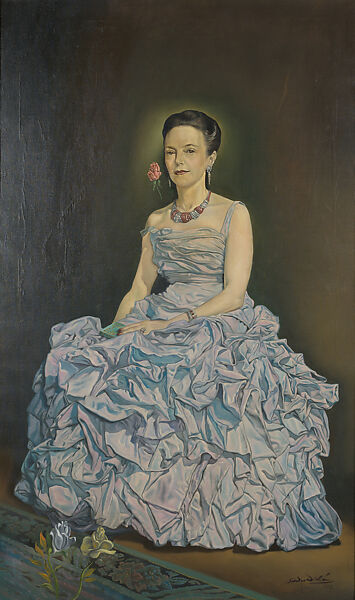
Berthe David-Weill
A young Salvador Dalí crossed paths with Berthe Weill, an incredibly important art dealer who elevated new artists. If Dalí painted her portrait around this time, as he was diving into Surrealism, it would have been more than just a likeness. Imagine a painting with Dalí’s early, razor-sharp detail, but also a strange intensity or a subtle, dreamlike quality—a peek into her inner world. Such a portrait was vital for Surrealism because it showed this radical new art wasn’t only about bizarre landscapes. It proved Dalí could use his unique surreal lens to reveal hidden depths in real people, making Surrealism a powerful tool to explore the everyday in a profound, unsettling new way and solidifying his own rising importance.
Artist:Salvador Dali
Date: 1952
Medium: Oil on canvas
Dimensions: 40 1/8 in. × 24 in. (101.9 × 61 cm)
Rights and Reproduction: © 2025 Artists Rights Society (ARS), New York
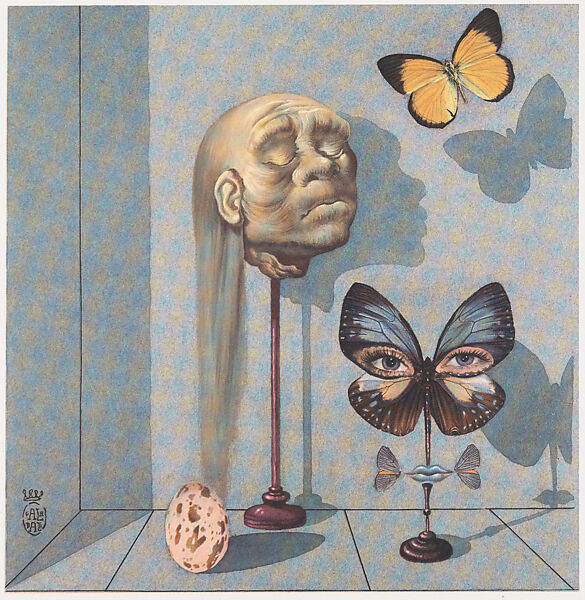
Publisher’s proof for the cover of Maurice Sandoz, ‘La Limite’ (Paris 1951)
By 1951, Salvador Dalí was a global superstar, his surreal art instantly recognized everywhere. So, when author Maurice Sandoz needed a striking cover for his fantastical book, ‘La Limite,’ Dalí was tasked with creating it. The resulting publisher’s proof for the cover would have been pure Dalí: imagine strange, dreamlike symbols and unsettling scenes, all painted with his famous razor-sharp precision, designed to intrigue and draw you in. This book cover was important for Surrealism because it brought Dalí’s unique vision directly into the hands of the public, far beyond art galleries. It proved his iconic style could make people curious about the mysterious and the subconscious, showing that Surrealism’s power to fascinate was still strong, largely thanks to Dalí’s widespread influence and his ability to make its strange beauty accessible to all.
Artist: Salvador Dalí (Spanish, Figueres 1904–1989 Figueres)
Date: 1950
Medium: Chromolithograph (?)
Dimensions: Sheet: 11 13/16 × 7 3/4 in. (30 × 19.7 cm)
Plate: 7 1/2 × 7 5/16 in. (19 × 18.5 cm)
Rights and Reproduction: © 2025 Artists Rights Society (ARS), New York

